
Dynamic contact resistance (DCR) testing plays a critical role in ensuring long-term reed switch reliability. While reed switches appear simple, the act of switching involves complex mechanical and electrical interactions that can lead to premature failure if not properly tested.
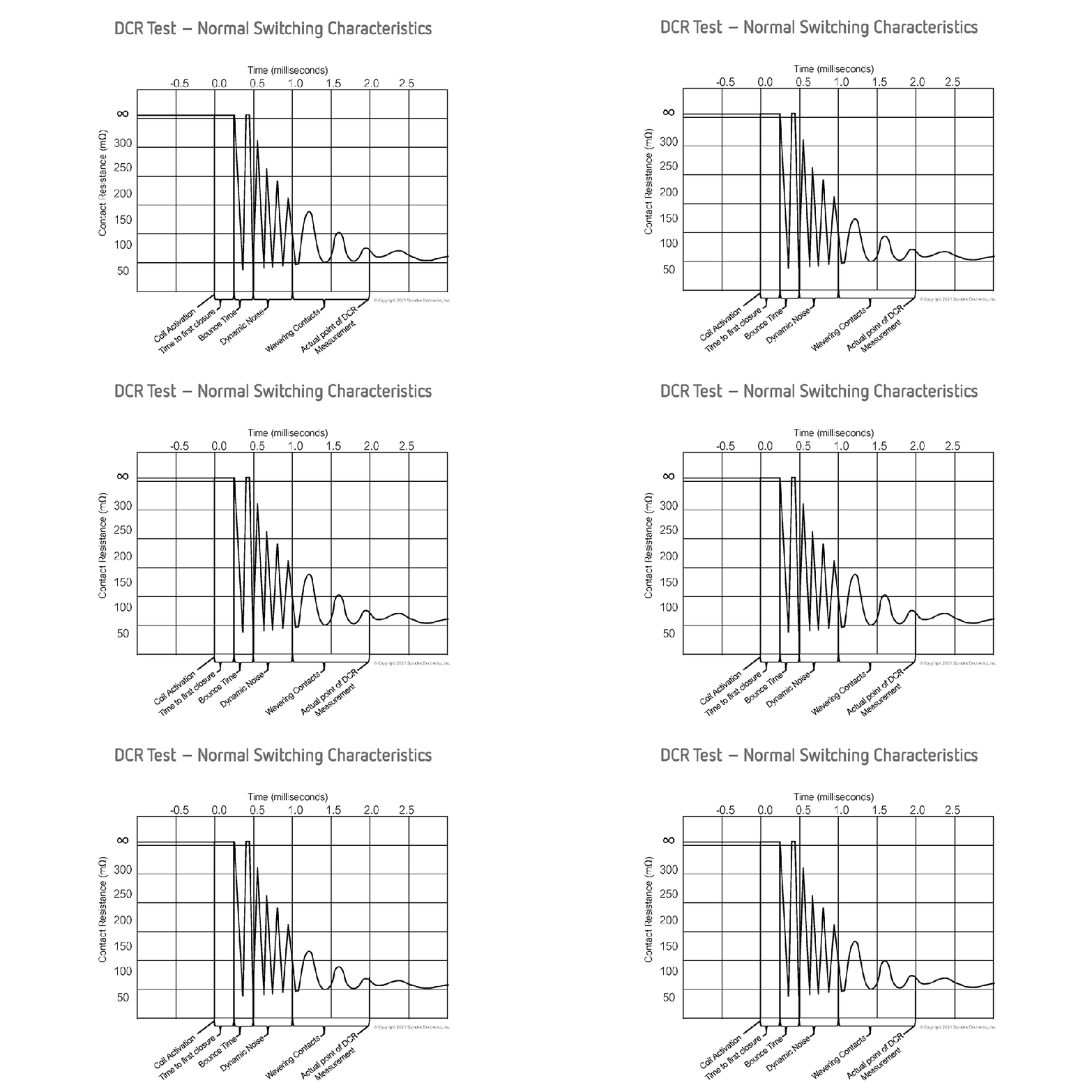
Dynamic contact resistance is a “true” test and a way of measuring the contact resistance of reed switches to ensure fault free operation, and maximum switching efficiency.
If there are particular areas you need help with, feel free to skip to any of the following sections:
- Introduction
- What is Dynamic Contact Resistance Testing?
- Why Dynamic Contact Resistance Matters for Reed Switch Reliability
- What Causes DCR Test Failures?
- Key Factors That Affect DCR Test Results
- Conclusion: Why 100% DCR Testing Is Essential
Introduction
Dynamic contact resistance (DCR) testing plays a critical role in ensuring long-term reed switch reliability. While reed switches appear simple, the act of switching involves complex mechanical and electrical interactions that can lead to premature failure if not properly tested.
DCR testing allows manufacturers to detect hidden defects early, improve switching efficiency, and ensure fault-free operation in demanding applications.
What is Dynamic Contact Resistance Testing?
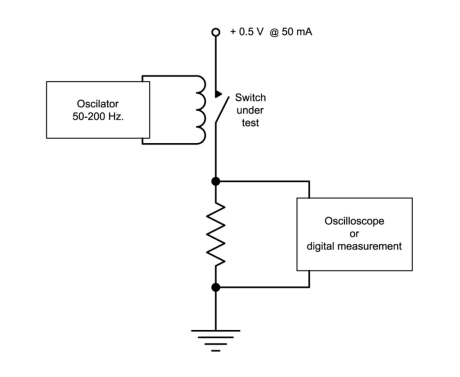
Dynamic contact resistance is a “true” test and a way of measuring the contact resistance of the reed switch blades. This testing ensures that all tools being utilized are not adversely affecting the reed switch. Furthermore, the test eliminates premature failures and improves long term reliability in the equipment and technical systems.
A DCR test is the most accurate and efficient way to examine the condition and ability of the reed switch.
Why Dynamic Contact Resistance Matters for Reed Switch Reliability
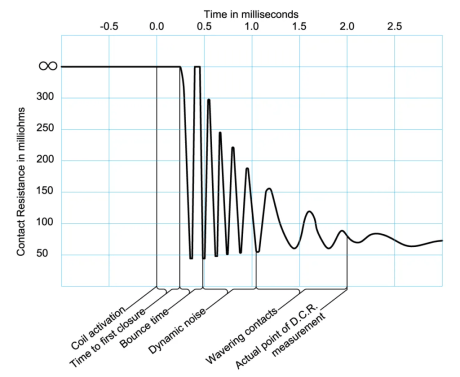
Our typical dynamic contact resistance test consists of operating the reed contacts at about 100 times per second. At that rate, we look for a measurement of the contact resistance about 1 millisecond after the contacts close. If the contacts are clean (meaning no contaminants on the contacts) and the reed switch is intact, we usually get a positive result.
However, if there is the slightest problem, the contact resistance will not have settled down within one millisecond timeframe. Resulting in a rejected or failed reed switch.
A DCR test is the most accurate and efficient way to examine the condition and ability of the reed switch. Additionally, DCR testing helps to determine if anything needs to be corrected during the manufacture of reed switches.
Many things can prove to be a disruption in regards to a reed switch’s function. These disruptions listed below can cause a DCR failure:
- Overstressed reed switch usually from assembly
- Small crack on the reed seal
- Broken reed switch
- Plating or sputtering peeling off the contact area
- Air contamination in the glass capsule
- Particles on the reed contacts
What Causes DCR Test Failures?
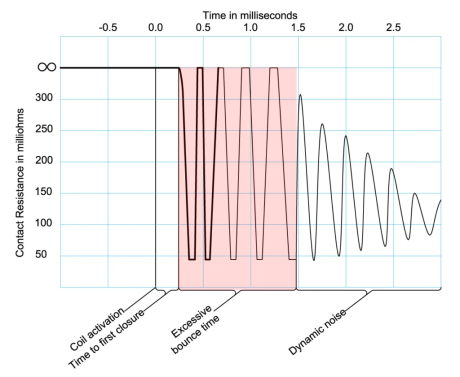
Below are some examples of electrical patterns showing various DCR failures.
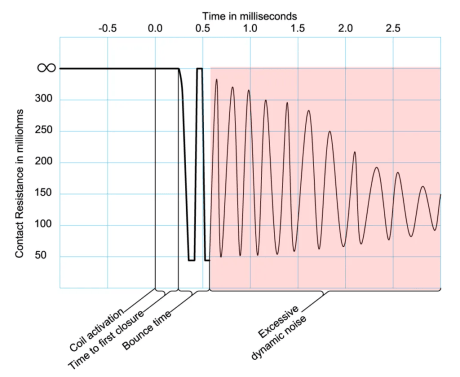
Excessive Contact Bounce
DCR Failure “Excessive Contact Bounce” indicating a weak contact closing force sure to shorten the life of the switch
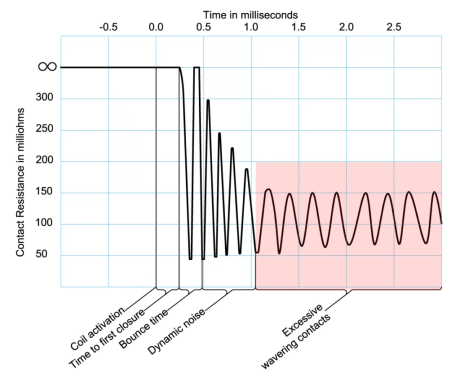
Excessive Dynamic Noise
DCR Failure “Excessive Dynamic Noise” and “Excessive Contact Wavering” both caused by potential stressed or cracked glass switch seal
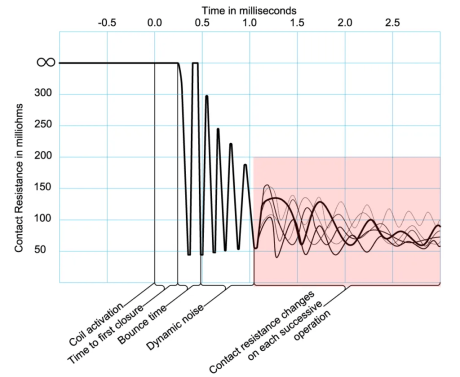
Changing Contact Resistance
DCR Failure “Changing Contact Resistance” caused by contact contamination, seal leak, particles, or peeling plating
Key Factors That Affect DCR Test Results
When completing a DCR test, there are a few different factors that will determine the approach of the test that is taken. For example, the test that you run and the results that you get will be based on the below five factors.
1)
Reed Switch Size
Reed switch size has a direct impact on dynamic switching behavior. Larger reed switches have greater inertia and stiffer reed blades, which results in longer initial contact closure times. This increased stiffness also amplifies the effects of contact vibration during switching.
In contrast, smaller reed switches have less inertia and more flexible reed blades, allowing them to close more quickly and with reduced mechanical stress. As a result, smaller reeds typically exhibit shorter closure times and different dynamic characteristics during DCR testing.
2)
Inductance of the Coil
Reed switch size is closely tied to the inductance of the actuating coil. Larger reed switches require magnetically stronger, more inductive coils to initiate contact closure. The inductance of the coil influences how quickly the magnetic field builds and collapses, which directly affects the switching speed and dynamic behavior of the reed contacts.
Variations in coil inductance can significantly influence the measured dynamic contact resistance and must be carefully controlled during testing.
3)
Harmonic Motion
When the reed contacts close, they do so with momentum that causes the reed blades to vibrate. This vibration is known as critically damped harmonic motion and is a key factor in dynamic contact resistance testing.
During this motion, the reeds vibrate microscopically within the glass capsule. The magnitude and duration of this vibration affect contact bounce, dynamic noise, and the stability of the contact resistance measurement.
4)
Applied Voltage
As the reeds vibrate within the magnetic field generated by the coil, their motion induces a small electrical current in the metal. This induced current is an essential component of the DCR measurement.
The applied voltage influences both the magnetic field strength and the resulting induced current, making it a critical parameter in accurately measuring dynamic contact resistance during switching.
5)
Overdrive Level
The overdrive level refers to the voltage or current applied beyond the reed switch’s pull‑in (closure) point. This parameter determines the operating condition under which the DCR measurement is taken.
Proper control of coil overdrive is essential, as insufficient overdrive may lead to inconsistent closure, while excessive overdrive can mask defects or introduce unnecessary mechanical stress. Selecting the correct overdrive level ensures accurate and repeatable DCR test results.
Conclusion: Why 100% DCR Testing Is Essential
Reed switches provide us with a unique ability to utilize opening and closing contacts in virtually any environment with a simple magnet, enabling a large space for switching innovation. Dynamic contact resistance testing is a must in order to ensure a fault free operation, maximum efficiency and continued reed switching innovation. For this reason, Standex Detect DCR tests 100% of our reed-switch based components to ensure its customers get the highest quality and reliability.
Get in touch with our team to learn more about our carefully engineered solutions.
Related Articles
-

High-Voltage Insulation Monitoring for Next-Generation BESS
Learn how insulation monitoring helps improve safety, reliability, uptime, and asset protection in Battery Energy Storage Systems (BESS). Explore high-voltage monitoring solutions for 1,000–1,500 VDC energy storage applications.
-
When Standard Sensors Aren’t Enough
Real-world applications rarely operate under ideal conditions. Temperature extremes, fluid exposure, vibration, contamination, and limited installation space can all impact sensing performance and long-term reliability. Learn how custom sensor solutions help overcome these challenges and deliver reliable operation in demanding industrial, transportation, EV, agricultural, and energy applications.
-
Reliable Sensing for Safer, More Efficient EV Systems
Learn how reliable sensing supports safer, more efficient EV systems. Explore applications in battery management, charging systems, fluid monitoring, and safety detection and discover how advanced sensing technologies help improve performance, reliability, and operational safety.
-

Designing High-Density Switching Architectures Without Sacrificing Precision
Learn how engineers can increase channel density while managing capacitance, crosstalk, and PCB design constraints in modern semiconductor test systems.
-
Eliminating Downtime in Motion Systems with Precision Sensing
Learn how precision sensing helps eliminate downtime in industrial motion systems. Explore real‑world applications in automation, high‑power loads, and fluid‑dependent systems and see how reliable sensing improves uptime and system performance.