
From Cable Harness Testing to Semiconductor ATE
Accurate switching of high voltages directly influences measurement accuracy, stability, and throughput. In high‑impedance and insulation tests, leakage paths dominate error budgets, while parasitic capacitance limits settling time in multiplexed architectures. The right relay technology and careful PCB/Layout practices are essential to meet performance targets without sacrificing channel density.
If there are particular areas you need help with, feel free to skip to any of the following sections:
- Critical Considerations in High‑Voltage Test System Design
- Challenges in High-Voltage Switching
- Reed Relay Technology in High-Voltage Systems
- The Standex SHV Relay Family
- High-Voltage Test Application Examples
- Design Considerations in High-Voltage Testing
Critical Considerations in High‑Voltage Test System Design
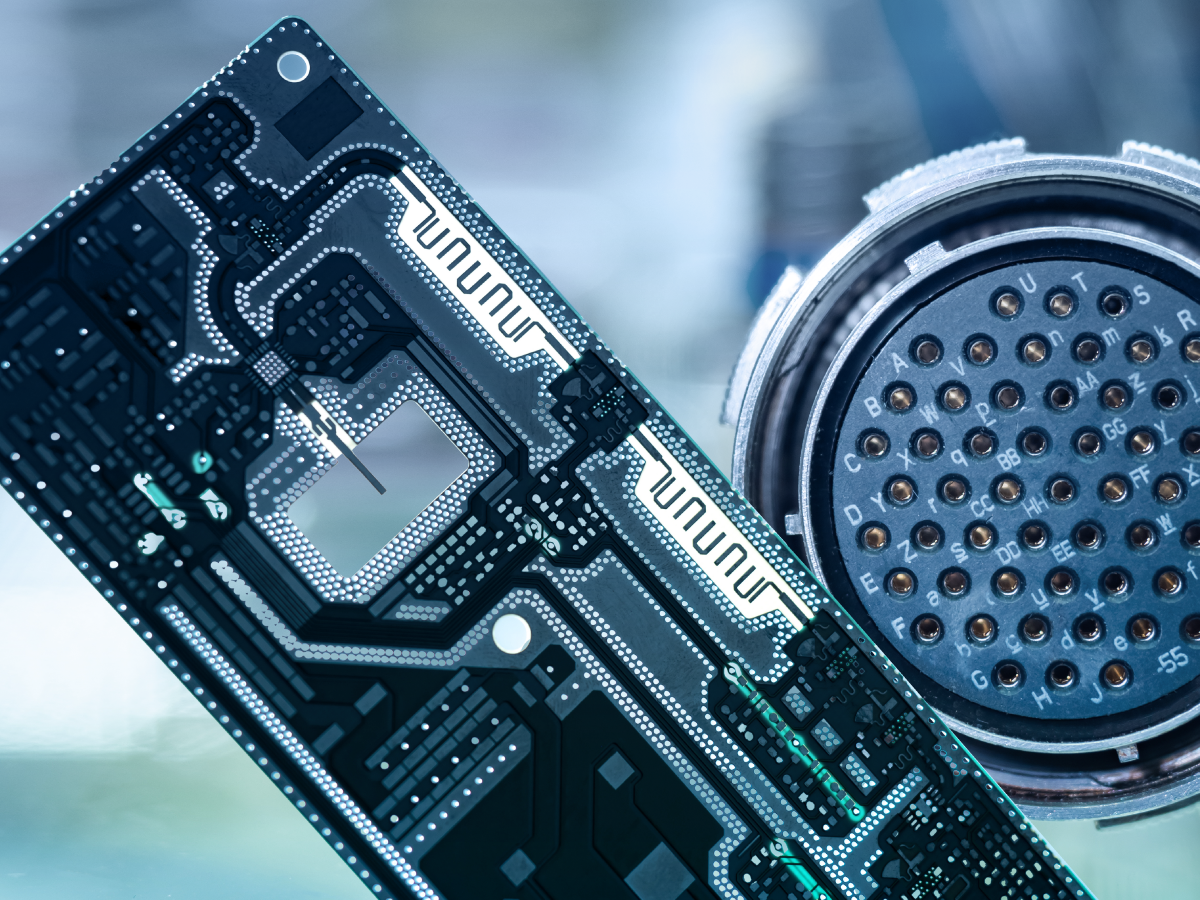
Accurate switching of high voltages is a fundamental requirement in modern test systems, directly influencing measurement accuracy, stability, and throughput. In applications such as semiconductor ATE or cable harness testing, the switching element becomes part of the measurement path and must meet the same performance expectations as the instrumentation itself.
As voltage levels increase and tolerances tighten, effects such as leakage current and parasitic capacitance define system limits and can no longer be treated as secondary considerations. Selecting the right switching technology is therefore a key design decision.
Reed relays are widely used in these environments because they combine high isolation with very low parasitic effects, enabling precise and repeatable measurements across a broad range of high-voltage applications.
Check out the full list
of Standex’s testing
and certifications:
of Standex’s testing
and certifications:
- AEC-Q200
- IEC 60810-4
- IEC 60601-1
- IEC 62109-1/2
- IEC 60664-1
- ISO 6469-3
- IEC 60255-27
- UL Listed
- RohS, REACH
Challenges in High-Voltage Switching
In precision test systems, leakage current is often the dominant source of measurement error. This is particularly critical in insulation testing and high-impedance measurements, where even very small leakage paths can distort results or reduce repeatability over time.
Parasitic capacitance introduces another constraint. It increases settling time and enables channel-to-channel coupling in multiplexed architectures, limiting achievable throughput.
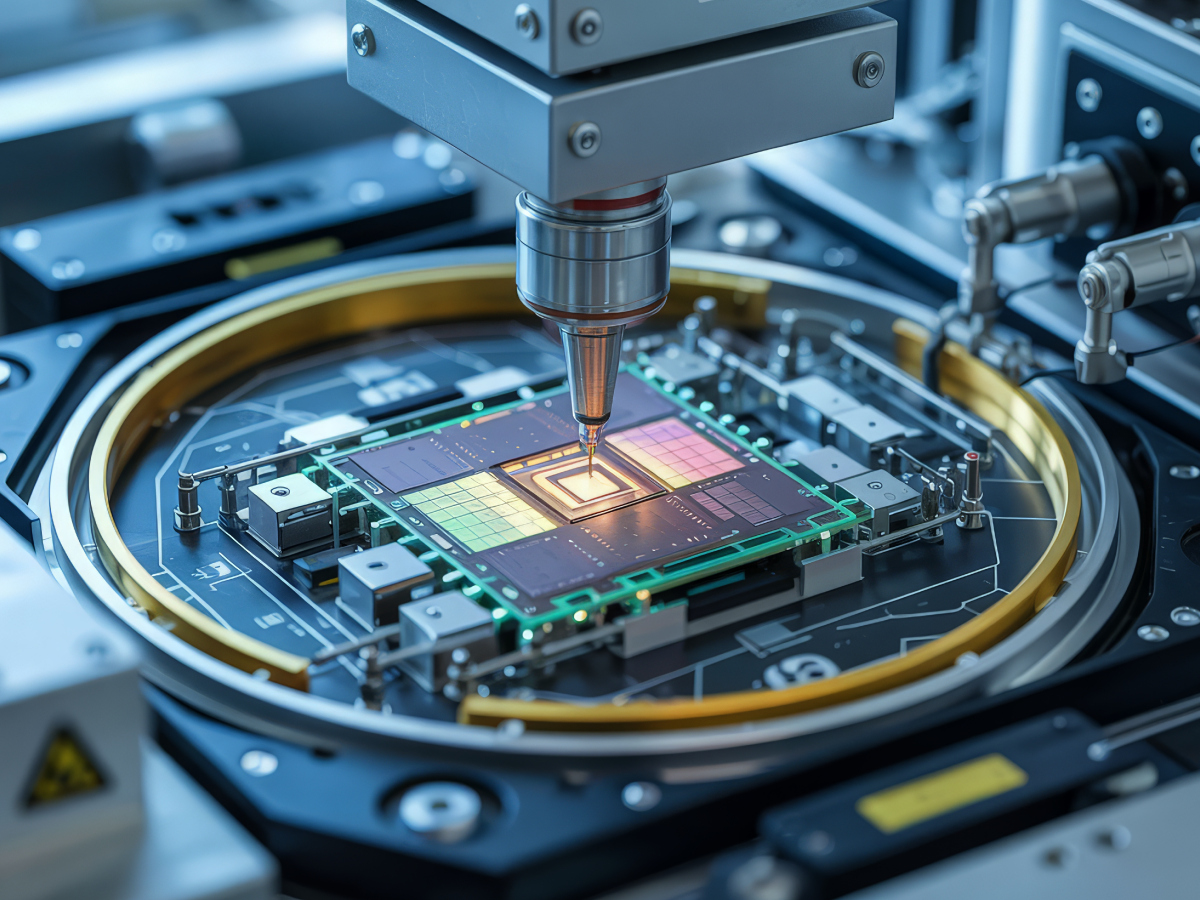
At the same time, system designers are under pressure to increase density and reduce footprint. This creates a trade-off between compact design and electrical performance, where switching components must maintain high isolation and low parasitics within limited space.
Key Design Constraints
Key design constraints in high-voltage switching include:
Leakage Current
Minimizing leakage current to preserve measurement accuracy
Parasitic Capacitance
Reducing parasitic capacitance for faster settling times
High Isolation
Maintaining high isolation in compact, high-density layouts
Increasing density
and shrinking
footprints
force designers
to balance
compact layouts
with the need
for high isolation
and low parasitics.
and shrinking
footprints
force designers
to balance
compact layouts
with the need
for high isolation
and low parasitics.
Reed Relay Technology in High-Voltage Systems
Reed relays address these challenges through their inherent physical construction. Hermetically sealed contacts ensure leakage in the picoampere range, while the contact geometry results in sub-picofarad capacitance. This combination allows accurate switching of high voltages without introducing significant measurement error.
Compared to other switching technologies, reed relays offer a balanced performance profile that prioritizes signal integrity. Alternatives may offer advantages in specific areas such as switching speed or lifetime, but often at the expense of leakage or capacitance, which limits their suitability for precision measurement systems.
For high-voltage test applications where accuracy and repeatability are critical, reed relays remain a preferred solution.
Switching Technology Comparison
| Attribute | Reed Relays | Solid-State Relays | Electromechanical Relays |
|---|---|---|---|
| Leakage current |  Very low Very low |  High High |  Moderate Moderate |
| Parasitic capacitance | Very low | High | Medium |
| Isolation performance | High | Limited | Good |
| Switching speed | Fast | Very fast | Slow |
The Standex SHV Relay Family
The Standex SHV series is developed for high-voltage test and measurement applications, combining compact design with stable electrical performance. The family now includes both single-channel and dual-channel configurations, enabling flexible system design.
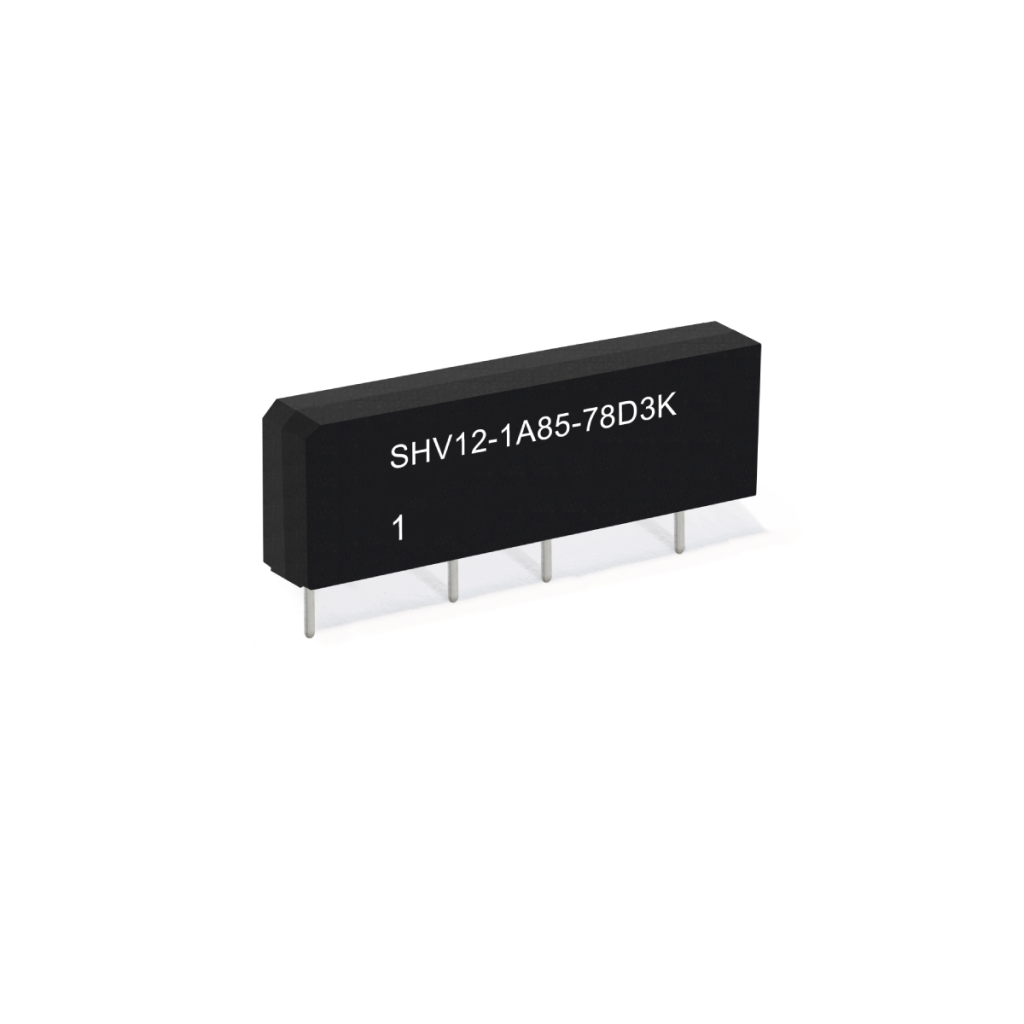
The SHV-1A with one channel Normally Open contact (Form A) is a proven solution widely used in automated test systems, cable harness testing, instrumentation or Battery Management of Energy Storage Systems. It provides reliable high-voltage switching with stable insulation characteristics and has established a strong track record in the field.
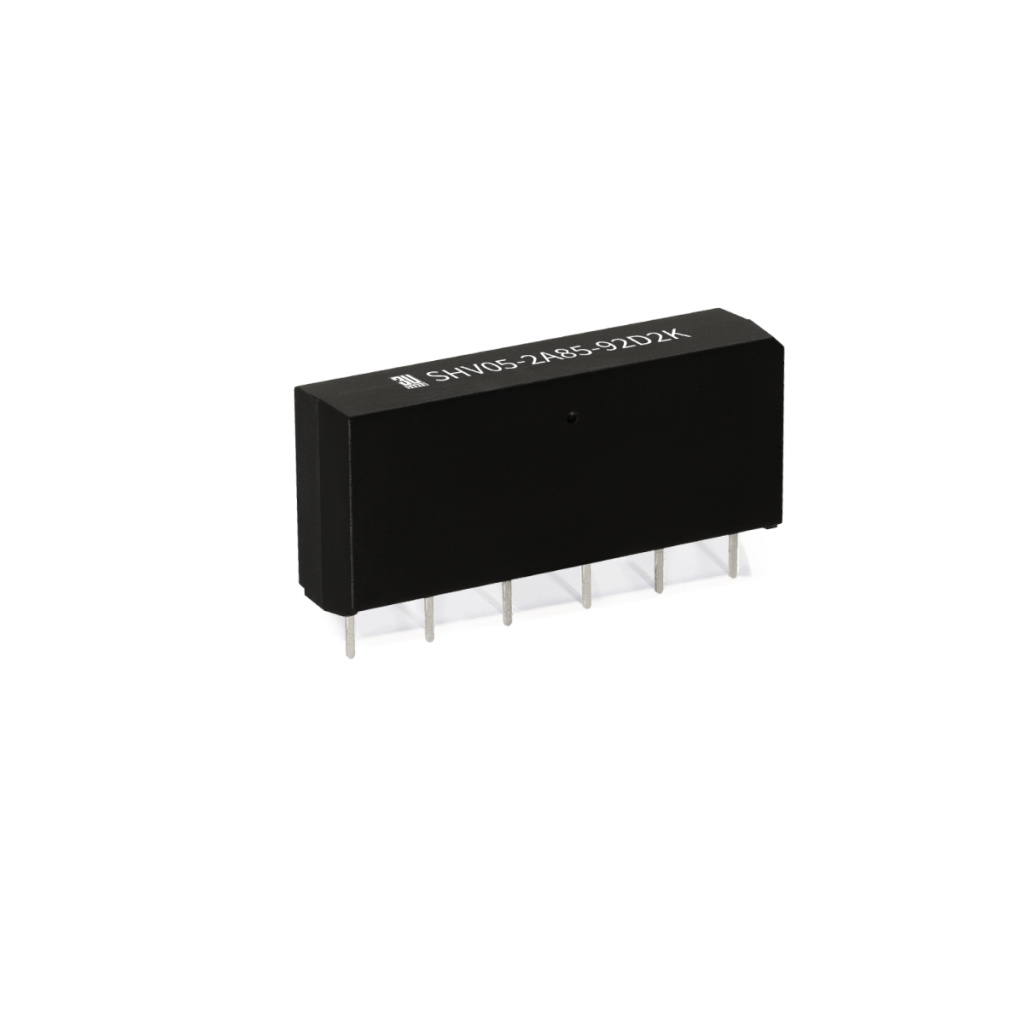
The SHV-2A expands this platform by introducing a dual-channel configuration (2x Form A) within a similar footprint. This enables higher channel density and more efficient system architectures without compromising electrical performance.
Key characteristics of the SHV family include:
- High insulation resistance supporting accurate measurements
- Very low capacitance enabling fast signal settling
- Compact form factor for high-density switching matrices
- Consistent performance over long operational lifetimes
The SHV-2A supports switching voltages up to 1 kV with breakdown capability up to 2 kV, or 1.5 kV switching and 3 kV Breakdown voltage depending on configuration combined with insulation resistance in the teraohm range and capacitance as low as 0.5 pF.
These parameters translate directly into improved system accuracy and efficiency. By combining proven single-channel performance with a dual-channel option, the SHV family allows designers to scale systems more effectively while maintaining measurement integrity.
SHV Series – At a Glance
SHV-1A
- Form A (NO)
- Proven in ATE, harness testing, instrumentation
- Stable insulation characteristics in a compact footprint
SHV-2A
- 2× Form A in similar footprint (higher density)
- Switching: 1.0–1.5 kV; breakdown up to 3 kV
- Insulation resistance in TΩ range; capacitance ≈ 0.5 pF
High-Voltage Test Application Examples
High-voltage cable and harness testing requires switching across large matrices while preserving insulation measurement accuracy. In EV and aerospace systems, leakage paths directly distort insulation readings, so the switching element must maintain high isolation under high voltage. Reed relays enable reliable routing across multiple channels while supporting compact matrix architectures.
Used in high-voltage harness testers for Aero-MIL or in production test systems for analog and mixed-signal semiconductors.
In semiconductor ATE, switching elements are part of parametric measurement paths and signal routing networks. Parasitic capacitance limits settling time, while leakage current impacts low-level measurement accuracy. Reed relays minimize both effects, supporting fast and repeatable measurements at high test volumes.
Functional PCB testing involves switching between multiple nodes in mixed-signal environments. High-voltage rails coexist with sensitive measurement points, requiring switching components that maintain isolation and low parasitics within limited space. Reed relays support compact layouts while maintaining signal integrity.
Battery and energy storage testing requires stable switching under elevated voltages for diagnostic and safety functions. Leakage and drift can affect insulation monitoring and measurement consistency. Reed relays provide predictable electrical behavior over time, supporting reliable system evaluation.
Typical applications include:
- High-voltage cable and harness testers
- Semiconductor automated test equipment
- Functional and in-circuit PCB testing systems
- Battery and energy storage diagnostics

Design Considerations in High-Voltage Testing
Achieving optimal performance in high-voltage switching systems requires careful integration of the relay into the overall design. PCB layout plays a critical role, particularly in maintaining adequate creepage and clearance distances and minimizing unintended leakage paths.
Proper switching conditions, including avoiding switching under load where possible, help extend relay lifetime and maintain consistent performance.
System architecture should also consider relay placement and signal routing to minimize parasitic effects and ensure clear separation between high-voltage and sensitive measurement areas.
Important design aspects include:
- PCB layout with controlled creepage and clearance
- Minimization of leakage paths through proper material and design choices
- Controlled switching conditions to avoid electrical stress
- Optimized relay placement for signal integrity
Design Considerations for High-Voltage
| Do | • Use guarding in high‑impedance circuits • Maximize creepage/clearance on PCB • Place relays away from sensitive nodes • Switch without load when possible |
| Don’t | • Route HV near analog sense lines • Ignore board contamination (affects leakage) • Overlook cumulative capacitance in large matrices • Underspec isolation for worst‑case conditions |
 Best Practices Best Practices | • Surround high‑impedance nodes with a driven guard net at the same potential. • Keep guard trace continuous and isolate it from HV. • Use clean, low‑leakage materials; avoid flux residues. |
For When it Matters
The Right Design, at the Right Time, at the Optimal Cost.
For over 50 years, Standex Detect has delivered engineered components that perform where precision and reliability are critical. Whether you’re developing semiconductor test equipment, EV systems, aerospace platforms, or high‑voltage instrumentation, our HV reed relays help ensure measurement accuracy, long‑term stability, and safe operation.
To learn more about how Standex Detect can support your high-voltage test and measurement projects with custom relay solutions, contact our engineering team to discuss your specific application needs.
Related Articles
-

An Essential Design Decision: Reed Switches Benefits
From extreme temperatures to high‑vibration environments, reed switches excel where other sensors fall short. Learn how their hermetically sealed design, fast switching, and long life make them an essential component across automotive, industrial, and smart‑device applications.
-
High Power Reed Sensors for Lamp Loads and High Inrush Current Industrial Applications
Industrial systems are becoming more electrified, driving higher power demands and challenges like high inrush currents, harsh environments, and the need for long‑lasting sensing. Standex Detect High Power Reed Sensors are built for these conditions, delivering durability, precision, and electrical robustness where traditional switches fall short.
-
Silent Protectors: Monitoring Critical Insulation Measurement in Medical and Energy Systems
Reed relays play a crucial role in maintaining safe, reliable insulation within high‑voltage medical and energy storage systems, where precision and protection are essential. Their high breakdown voltage, exceptional isolation, and low leakage current make them ideal for monitoring dielectric strength and preventing hazardous system failures. As voltages rise in technologies like advanced medical devices…
-
The Unseen Strength: High-Voltage Reed Relays for Cable Testers
High‑voltage testing demands components that ensure safety, reliability, and long‑term performance. Reed relays are engineered for these conditions, delivering high isolation voltage, exceptional insulation resistance, low ON resistance, and low capacitance. Their ability to switch everything from micro‑level signals to high‑power loads enables precise measurements across vast high‑voltage test systems.