
Magnetic Field Strength & Hall Effect Gauss Sensors
Analog Hall Effect Gauss Sensors provide an output that is proportional to the size and pole of the magnetic field strength in front of the sensing element. Hall effect gauss sensors are used in many different applications, measuring residual magnetization in machined steel, proximity and position tracking of components within an assembly, measuring the amplitude of current traveling down a conductor, and determining if electro-coils are activated.
Analog Hall Sensors for Measuring Field Strength
Hall Effect Sensors for Measuring Field Strength of Magnets (AH)
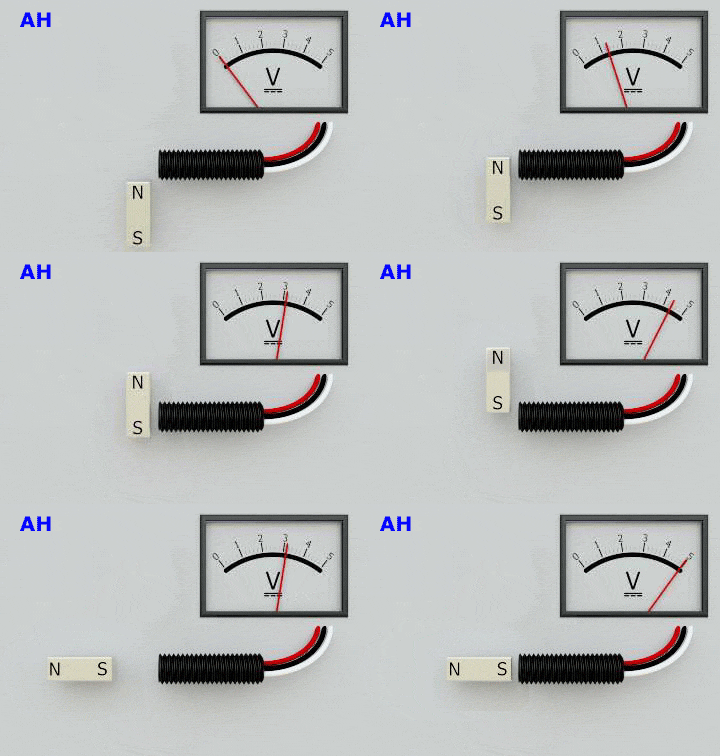
Centered Offset Analog Hall Sensors with Fixed Gains
AH and AH5 Analog Hall sensors provide an output of 2.5V with no magnetic field present when powered with 5.0V. A South Pole field increases the output towards 5V and a North Pole field decreases the output towards 0V.
- AH sensors have an internal gain of 2.5mV/G and can measure fields between +/- 1000 Gauss.
- AH5 sensors have an internal gain of 5.0mV/G and can measure fields between +/- 500 Gauss.
- AH and AH5 Analog Hall sensors are ratiometric. If the sensing element is powered with greater than 5.0V both the offset voltage and the gain increase. If the sensing element is powered with less than 5.0V the offset voltage and gain decrease. Both sensor types are offered with internal regulators for 12V or 24V power supplies (-RG). These regulators provide the sensing element with 4.8-5.2V. For the greatest precision measurement -5V options should be selected and powered with 5.0V.
Programmable Analog Hall Sensors
In addition to our AH and AH5 Analog Hall Sensors several styles of programmable Analog Hall sensors are also available, each with their own specific benefits.
- PAHx sensors offer a programmable offset voltage (0.05-4.95V) and programmable gain of 0.45-21.0mV/Gauss. These sensors are polarity sensitive, and are programmed to specific offset voltage, gain, temperature coefficient, clamp output, and slope (can be inverted so that a North Pole increases the output voltage).
- PAM sensors are polarity sensitive, and two field strengths are programmed into the chip. These points maybe determined and programmed using different gaps to a specific magnet. The sensor then calculates a gain between these 2 points, which determines the output voltage between the program points.
- PAL1 sensors are our fastest responding Analog Hall Sensors with a 120KHz response rate. They provide a 2.5V offset and a programmable gain of 1.3-2.9mV/G. PAL2 and PAL3 sensors are also available for applications requiring a higher gain.
Programmable Analog Hall sensors are ratiometric. If the sensing element is powered with greater than 5.0V both the offset voltage and the gain increase. If the sensing element is powered with less than 5.0V the offset voltage and gain decrease. Programmable sensors are offered with internal regulators for 12V or 24V power supplies (-RG). These regulators provide the sensing element with 4.8-5.2V. For the greatest precision measurement -5V options should be selected and powered with 5.0V.
Target magnets are available with the South Pole Marked for use with our sensors. Magnets are also available mounted into bolts and other threaded targets for easy installation.
When using magnets and Analog Hall Sensors the size shape, and material of the magnet will determine the gap range the sensor is able to detect. This Application Note provides charts showing operate gap ranges for different sensor types and magnet sizes.
Although the sensor gains are fixed, magnetic fields increase/decrease exponentially as the gap changes from the pole. When using Analog Hall sensors and permanent magnets the
If you do not find the Magnetic Field Measurement Sensor you need in our standard product offering or are not sure which option best fits your application, contact our Engineers to discuss a custom solution.