
Wireless home security systems demand sensors that are reliable, energy‑efficient, and built to operate for years without maintenance.As connected homes evolve, smart sensing technologies especially magnetic sensors play a critical role in enabling wireless security, remote monitoring, and low‑power IoT performance. In this article, we explore how smart sensing supports modern home security and why…

If there are particular areas you need help with, feel free to skip to any of the following sections:
- Why Smart Sensing Matters in Wireless Systems
- Smart Sensing That Brings Wireless Home Security to Life
- Connected Homes Enabled by Smart Sensors and Wireless Technology
- Types of Smart Sensing Solutions for Home Security
- Why Magnetic Sensors Are Ideal for Wireless Home Security
- Conclusion: Designing for a Smarter, More Connected Future
- Additional Resources
Why Smart Sensing Matters in Wireless Systems
Smart technology with integrated wireless features has grown rapidly in recent years. Today, smart sensing products are used across homes, vehicles, appliances, and connected devices.
This growth is driven by increasing demand for IoT‑enabled systems that improve convenience, safety, and energy efficiency especially in modern home security solutions.
For example, smartphones and handhelds have seen vast growth recently, with an equally occurring shift in home security systems. So, modern security systems that can be remotely accessed and controlled from mobile devices are steadily replacing basic ones. Modern homes rely heavily on smart magnetic sensors to detect, communicate, and trigger security events.
Smart Sensing That Brings Wireless Home Security to Life
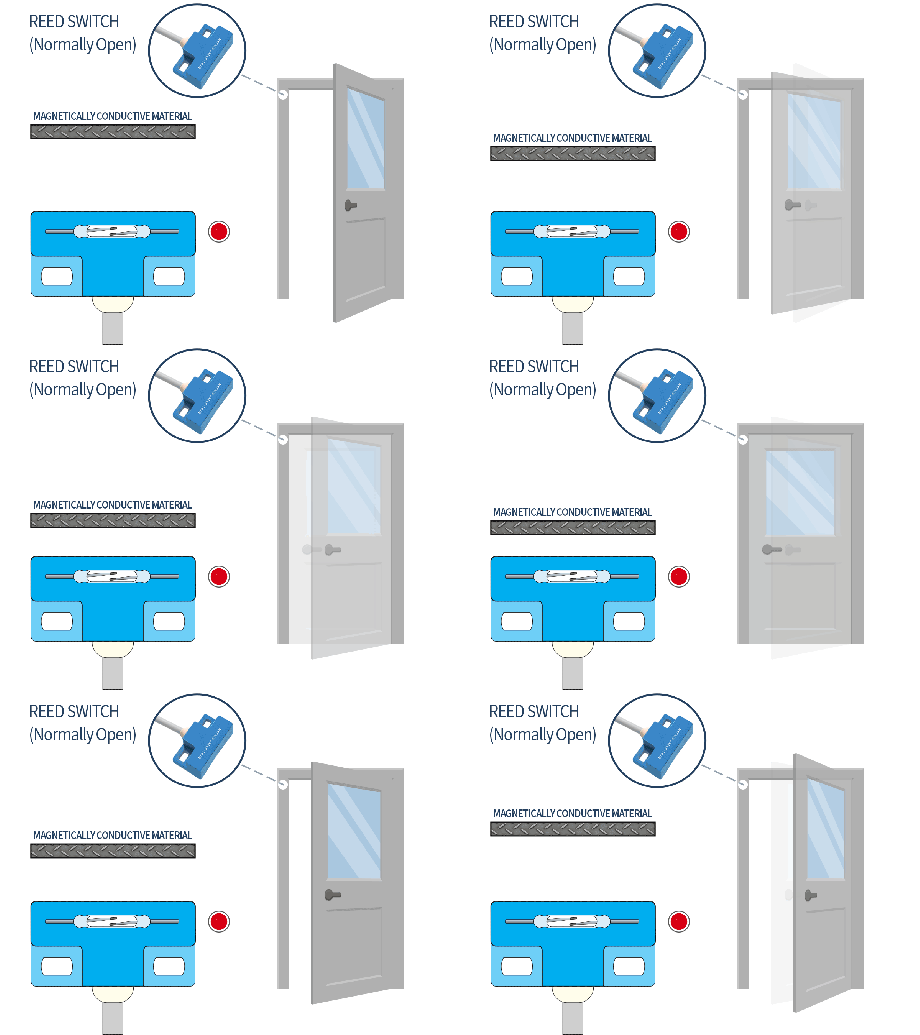
First, traditional security sensors were hard-wired to a central control panel. Second, analog sensors mainly detected fire or intrusion only, triggering a “normal” or “alarm” status. For example, a reed sensor and magnet typically mounted to doors and windows detected possible entry points. Then, opening the door or window caused the magnet and switch to lose contact, changing the sensor state from “normal” to “alarm”.
Additionally, fire and smoke alarms used optical, ionization, and temperature sensors. Magnetic reed switches were the basis in the “push to test” and proximity sensors.
These analog sensors reported the alarm status from the control panel to either a central security station or a local dispatch. In summary, technological growth has led to new and dramatic changes in sensor technology and Smart Home systems.

Connected Homes Enabled by Smart Sensors and Wireless Technology
One of the greatest changes to home security systems has been the arrival of remote monitoring and mobile access control. A few examples of remote sensing nowadays include:
- HVAC overflow and system health
- Power and water usage
- Door and window lock status
- Real‑time video and webcam feeds
Most importantly, homeowners can now remotely access and control home systems directly from their smartphone. For example, homeowners can change the thermostat, check if closed doors are locked or even lock them. Other controls include changing window shade position, turn lights on and off, and opening or closing garage doors. In other words, smart sensors transformed home security by giving consumers electronic access and control.
Types of Smart Sensing Solutions for Home Security
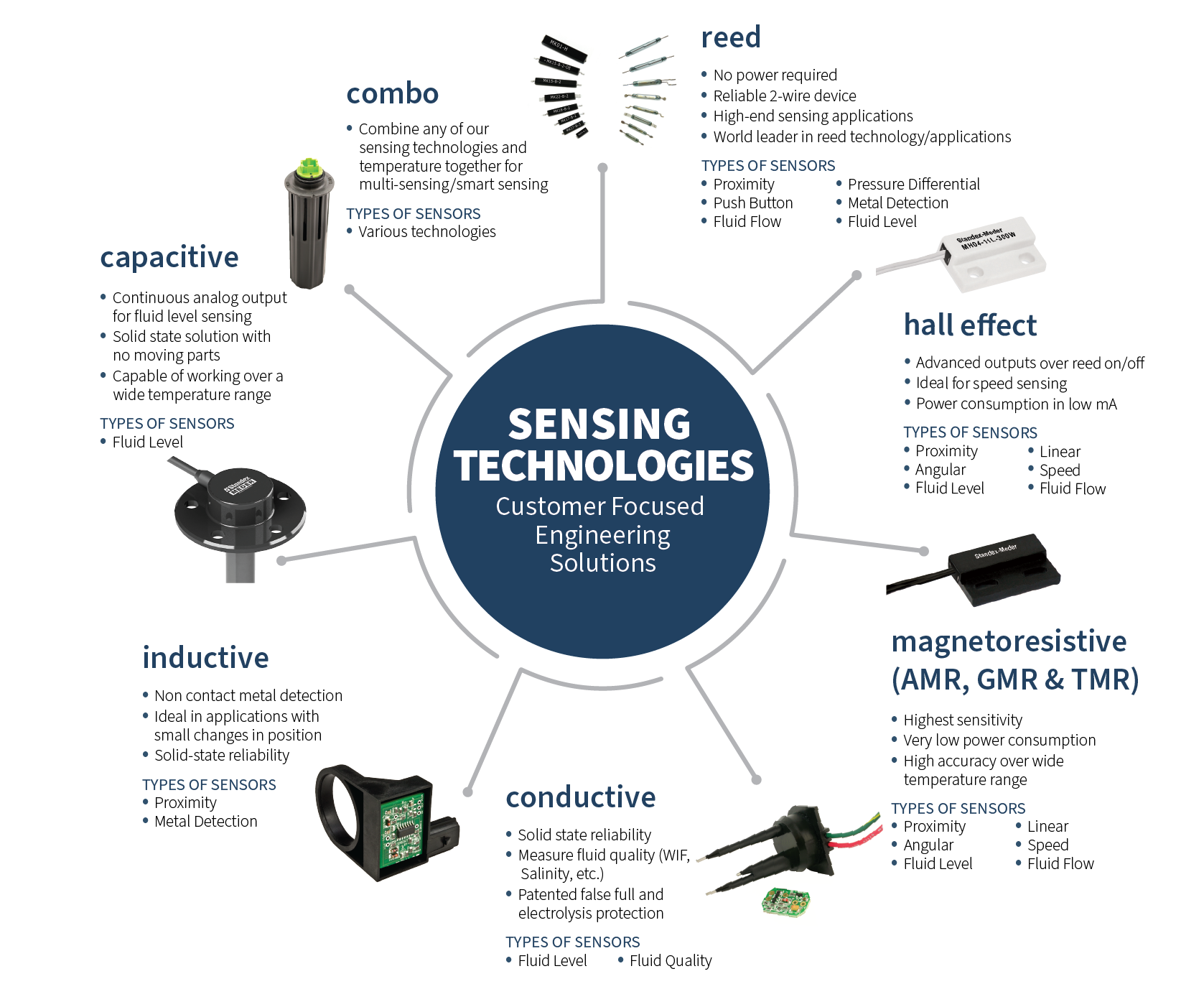
Other key additions in home security systems include monitoring and controlling sump pump levels and primary power usage. Nearly all new home appliances have some level of smart features requiring magnetic technology. Types of smart sensing solutions which are magnetically based include Reed switches, Hall Effect sensors, and current transformers.
Moreover, float type liquid level sensors may also use reed or electromechanical switches, or conductive technology. Although these applications are new, the core magnetic sensing element in smart homes is not. Electronic component companies like Standex Detect have been perfecting magnetic switching and sensing technologies for decades.
In summary, intrusion and fire sensors still largely function like they have in past decades. Conversely, most sensors today are wireless, battery powered, more reliable and easier to install. Now let’s explore why magnetic sensors make sense in smart home devices. The next section details magnetic sensors and what make each type unique.

Why Magnetic Sensors Are Ideal for Wireless Home Security
Magnetic sensors have some unique features that are very useful in household security applications. Below are some of the top features:
Ultra-low power consumption
Reed switches can operate with near‑zero standby power, making them ideal for battery‑powered wireless devices.
Long operation life
Reed switches and Hall sensors support millions of fault‑free cycles.
High electrical reliability
High open‑circuit breakdown voltage improves resistance to lightning and electrical transients.
Cost-effective design
Permanent magnets provide reliable actuation at low cost.
Conclusion: Designing for a Smarter, More Connected Future
Smart sensing is the foundation of today’s wireless world. By combining passive operation, long life, and exceptional signal integrity, reed‑based sensors enable reliable wireless systems across demanding environments.
Designing a wireless security or IoT device?
Talk with a Standex Detect engineer about custom magnetic sensing solutions built for low power, reliability, and long service life.
Additional Resources
Related Articles
-

High-Voltage Insulation Monitoring for Next-Generation BESS
Learn how insulation monitoring helps improve safety, reliability, uptime, and asset protection in Battery Energy Storage Systems (BESS). Explore high-voltage monitoring solutions for 1,000–1,500 VDC energy storage applications.
-

When Standard Sensors Aren’t Enough
Real-world applications rarely operate under ideal conditions. Temperature extremes, fluid exposure, vibration, contamination, and limited installation space can all impact sensing performance and long-term reliability. Learn how custom sensor solutions help overcome these challenges and deliver reliable operation in demanding industrial, transportation, EV, agricultural, and energy applications.
-

Reliable Sensing for Safer, More Efficient EV Systems
Learn how reliable sensing supports safer, more efficient EV systems. Explore applications in battery management, charging systems, fluid monitoring, and safety detection and discover how advanced sensing technologies help improve performance, reliability, and operational safety.
-

Designing High-Density Switching Architectures Without Sacrificing Precision
Learn how engineers can increase channel density while managing capacitance, crosstalk, and PCB design constraints in modern semiconductor test systems.
-

Eliminating Downtime in Motion Systems with Precision Sensing
Learn how precision sensing helps eliminate downtime in industrial motion systems. Explore real‑world applications in automation, high‑power loads, and fluid‑dependent systems and see how reliable sensing improves uptime and system performance.