
A reed relay is a compact electromagnetic switching device that uses a coil and sealed reed contacts to control electrical signals. In this guide, we explain what a reed relay is, how it works, and why it’s ideal for high-reliability applications.
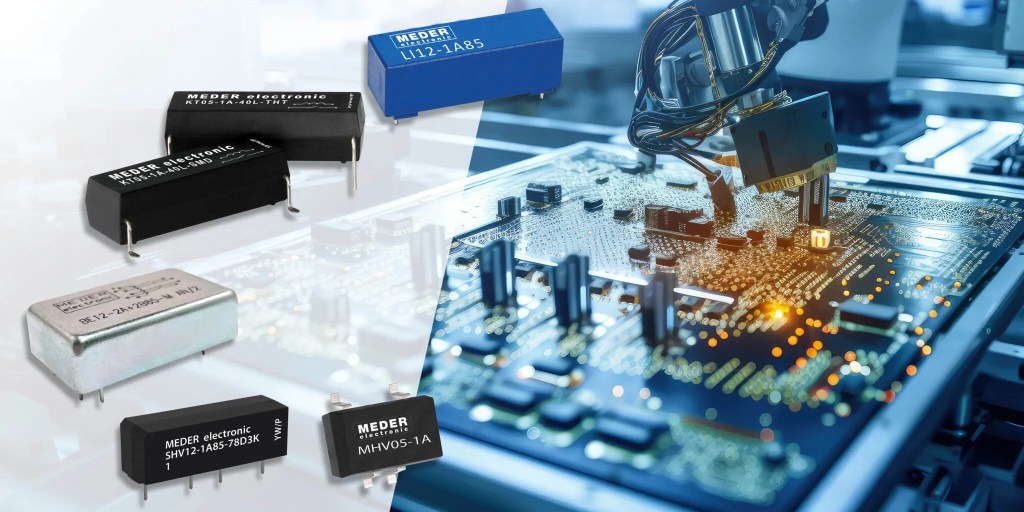
What is a reed relay? A reed relay is a small electromagnetic switching device that integrates a coil around one or more reed switches. The energized coil creates the magnetic field used to control the switching operation.
If there are particular areas you need help with, feel free to skip to any of the following sections:
- Introduction
- What is a Reed Relay?
- How Do Reed Relays Work?
- Types of Reed Relays
- What’s Makes Reed Relays Unique?
- Electrical and Mechanical Benefits
- Common Reed Relay Applications
- Conclusion
Introduction
In this blog we not only explain what a reed relay is but also some key performance features and common applications. The basis of the reed relay is Reed Technology which uses a magnetic field to control the switching operation. Simply put, a reed relay is a magnetic switching component integrated with an electromagnetic coil. Read on to learn more about what a reed relay is and what makes it so unique.
What is a Reed Relay?
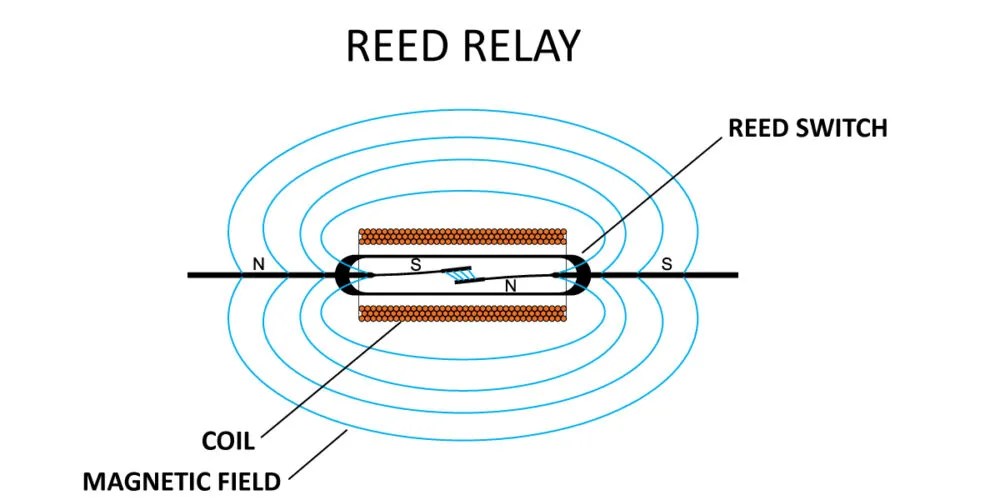
A reed relay is a small electromagnetic switching device. Reed relays are made by placing a coil around one or more reed switches. Typically, the relay assembly is then over-molded, or epoxy sealed into a housing for added durability and handling. Connection pins and/or free wires exiting the relay allow for PCB surface mounting or thru-hole assembly.
How Do Reed Relays Work?
Now that you know what a reed relay is, let’s explore how reed relays work. First, it helps to know the types of reed relays to understand how they work. Form refers to the relays’ internal switch contact configuration. There are four contact forms, Form A, B, C, and E.
Types of Reed Relays
Form A (Normally Open)
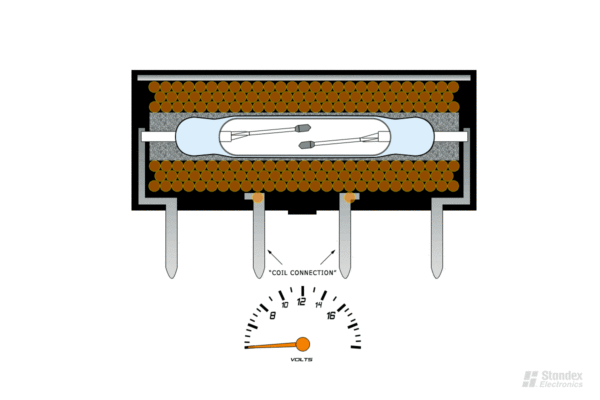
First, is the Form A type which is the most common and rests in a normally open (N.O.) switch state. Form A relays remain OPEN or OFF until current passes through the coil. The electromagnetic coil produces a magnetic field equal to a permanent magnet. Finally, the resulting magnetic field closes the contacts, switching the relay ON. Conversely, when the coil current is removed, the switch turns off and the contacts return to their open state.
Form B (Normally Closed)
Next is our second type Form B relays which have normally closed (N.C.) biased contacts held by a magnet. So, the relay rests in the closed or off state until the coil is energized, opening the contacts. De-energizing the coil switches the relay back to its closed or off position.
Form C (Changeover / SPDT)
Third, is the Form C relay which is uniquely comprised of three contacts compared to the typical two. They are normally open, normally closed, and common. The common contact will swing from the closed contact to the open contact when switched on. When OFF the contact reverts to its resting closed state. Therefore, Form C types are also referred to as a double throw switch.
Form E (Latching / Bistable)
The fourth and final type Form E is what we call a latching or bistable relay. This relay can exist in either the N.O. or N.C. state with no coil power using a biasing magnet. The relays’ contacts maintain their last assumed position without activating the coil. To change the state of the contacts, the magnetic field must be reversed.
What’s Makes Reed Relays Unique?
Reed relays perform uniquely in several ways, especially when compared to other relay technologies.
Because the reed switch contacts are hermetically sealed, they are protected from dirt, dust, and moisture. This design enables exceptionally long life and wear-free switching.
As a result, reed relays can switch low-level signals for billions of operations, far exceeding the life expectancy of conventional electromechanical relays.
Additionally, no other relay technology can switch zero voltage and current like the reed relays does! Moreover, semiconductor relays exhibit higher leakage current, and capacitance compared to reed technology. Therefore, offering many more unique advantages over other relay types. Read on to learn more about these performance features listed below.
Electrical and Mechanical Benefits
Reed Relays offer a wide range of unique switching advantages, including:
Key electrical advantages include:
- Long life, 10^9 operations (load dependent)
- Stable low contact resistance <150 mΩ
- High insulation resistance >10^14 Ω
- Switching up to 10,000 VDC
- Breakdown voltage/dielectric strength up to 15,000 VDC
- Carry currents up to 5 A continuous (10 A pulsed)
- Operate times 500 µs to 3 ms
- Very low signal switching in nanovolts range
- Wide range of coil resistances
- Tested in accordance with AEC-Q200 (KT series)
- Comply with UL, CSA, VDE, ATEX, IECEx etc. (select series)
Mechanical benefits include:
- Form A, B, C, and E types
- Hermetically isolated switches
- Reliable for intrinsic safety
- Shock resistant to 100 G, vibrations 50-2 kHz at 20 G
- Wide range of coil resistances
- Large selection of package styles and pin-outs
Common Reed Relay Applications?
You will find reed relays used extensively throughout test and measurement, medical, alternative energy, and hybrid and electric mobility markets. That is because reed relays offer perfect isolation between the control and load circuits. Also meeting the requirements of reliability, accuracy, speed, and safety. Other common uses include high cycle count, high voltage, low voltage, low current, or RF switching.
Furthermore, reed relays can have multiple switches and switch forms in a single package. So, it’s easy to imagine all the ways that a reed relay can be used. Especially, given all the above-mentioned relay types and the convenience of compact multi-pole relay. For instance, below is a list of some common reed relay application examples.
Applications
- Battery management, battery conditioning, power inverters
- High isolation from control to load circuit and across the relay contacts
- Carries very low current (detects current leaks)
- Meets creepage distances
Blog: Reed Relays for Isolation Measurement in Electric Vehicles
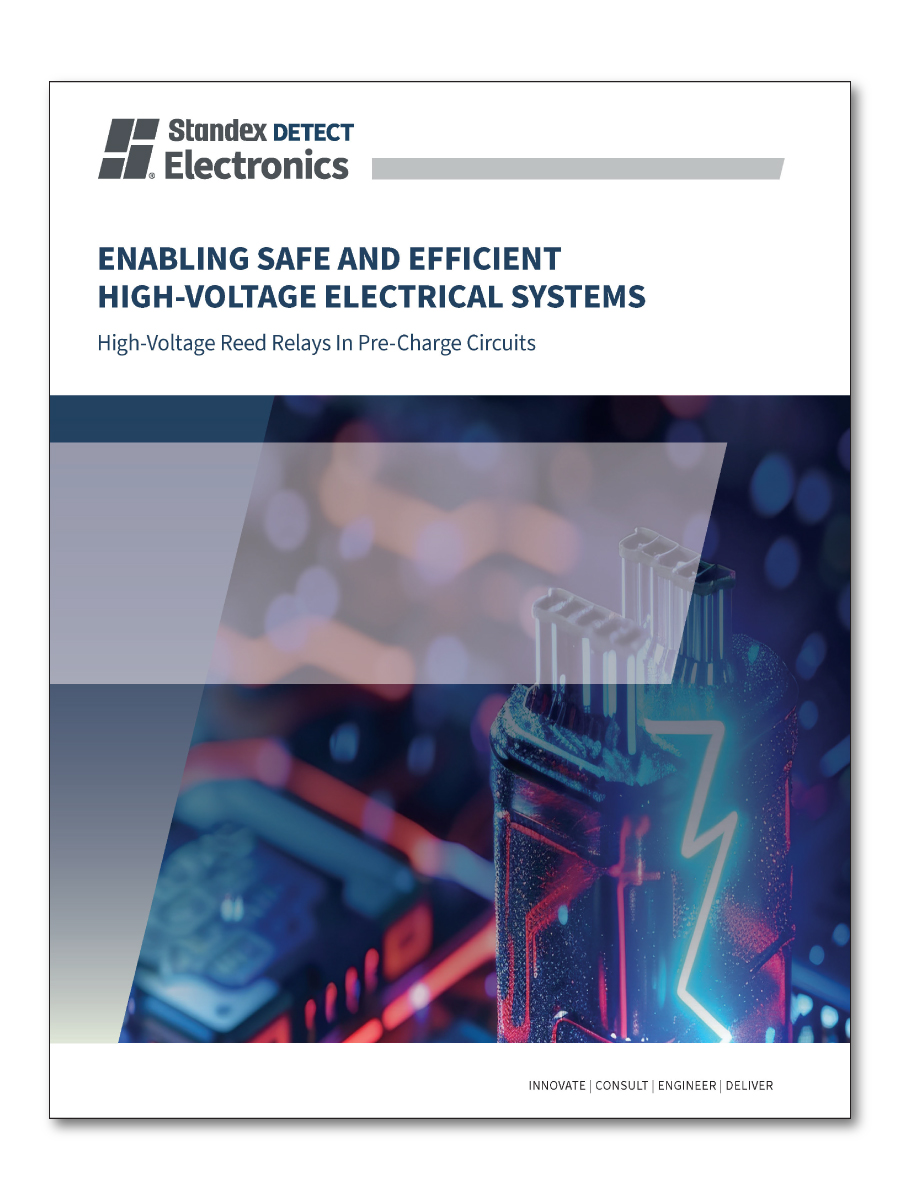
Pre-Charge Control in EV & Energy Storage
Design Problem:
Prevent inrush current when connecting high-voltage batteries to capacitive loads.
System Pattern:
- Close reed relay path through resistor
- Gradually charge capacitors (RC time constant)
- Close main contactor at ~90–95% voltage
- Open reed relay safely
Engineering Value:
- Prevents contact damage
- Enables controlled energy transfer
- Protects power electronics

High-Density Switching in ATE Systems
Design Problem:
Accurate measurement across thousands of test points
System Pattern:
- Relay matrices route signals between DUT and measurement units
- Must maintain signal integrity over millions of cycles
Why Reed Relays:
- Low thermal EMF
- Stable contact resistance
- Long life in high-cycle environments
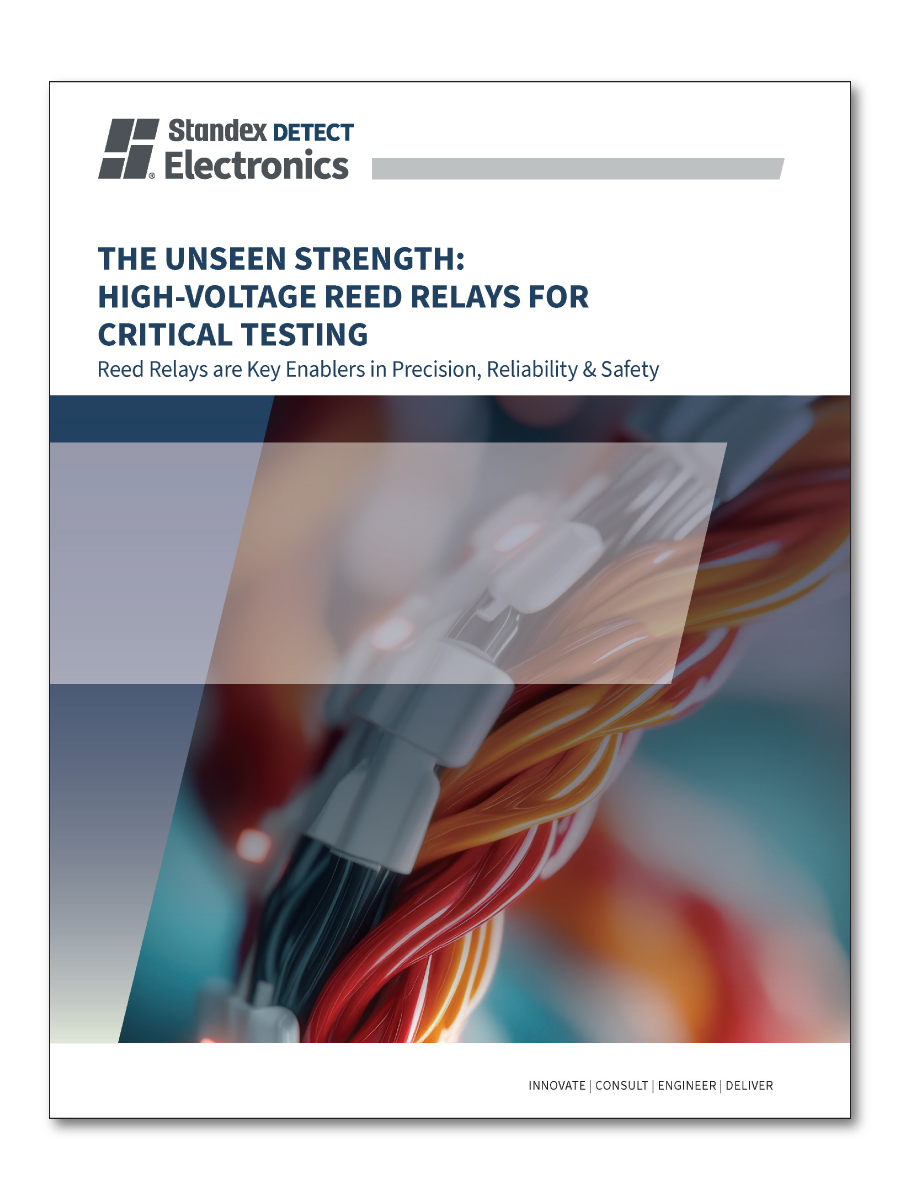
High-Voltage Cable & Harness Testing
Design Problem:
Detect micro-shorts and partial failures
System Architecture:
- Matrix scanning applies high voltage across all nodes
- High current paths validate conductor integrity
Engineering Requirements:
- Up to 10 kV testing capability
- High isolation between channels
- Ability to carry pulse loads
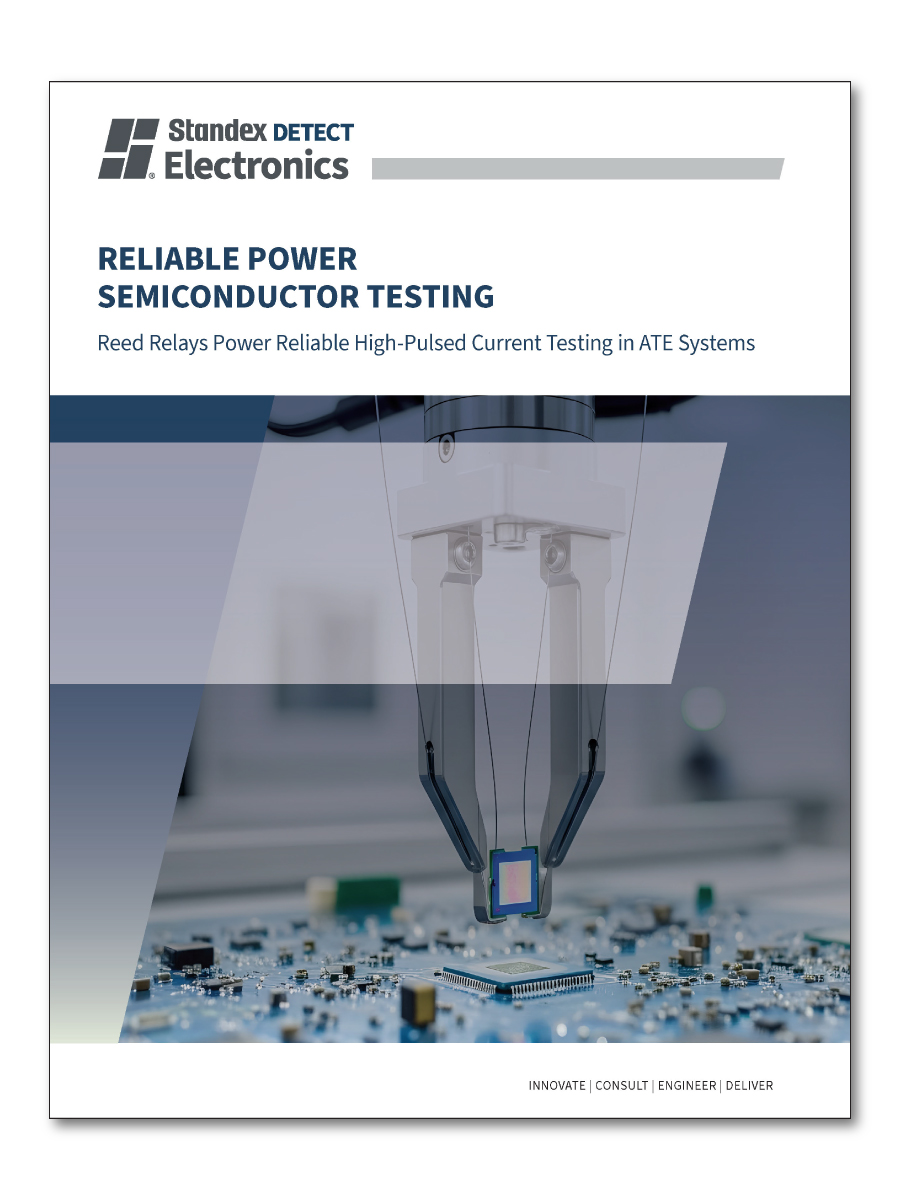
High-Pulsed Current Test Systems
Design Problem:
Generate clean high-current pulses without distortion
System Needs:
- Fast switching edges
- Low parasitic capacitance
- High current pulse handling
Reed Relay Benefit:
Supports clean waveform switching up to ~25A pulses
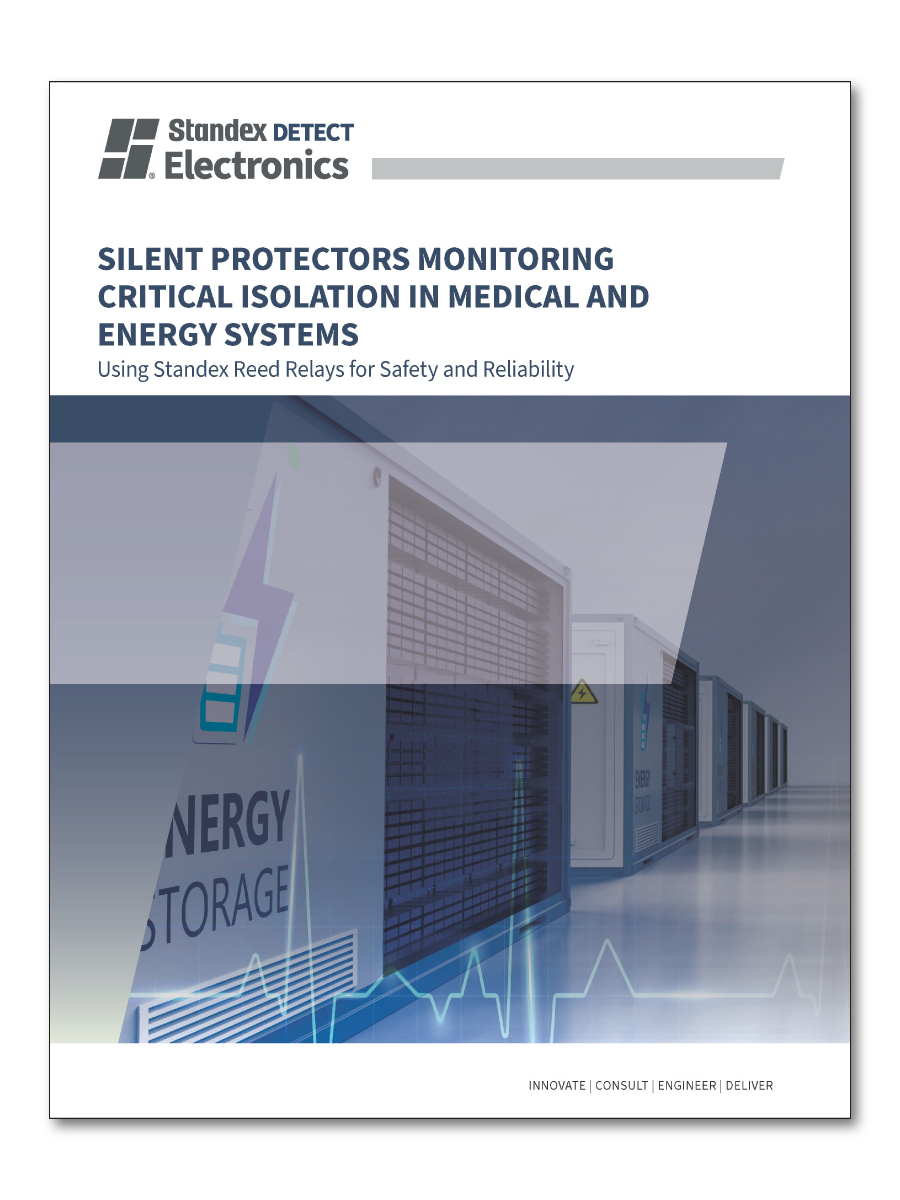
Safety Isolation in Medical and Energy Storage Systems
Design Problem:
Ensure patient safety in high-voltage environments
System Requirement:
- Absolute isolation between patient and equipment
Solution:
- Reed relays provide certified isolation (IEC 60601-1)
- Enable continuous isolation monitoring
Blog: Monitoring Insulation Measurement in Energy Storage Systems
Conclusion
In summary, a reed relay is a compact, high-performance electromagnetic switch that excels in low-level, high-reliability applications. Thanks to hermetically sealed contacts and exceptional electrical isolation, reed relays outperform many conventional relay technologies.
Standex Detect designs custom reed relays in a wide range of package styles and contact configurations. Contact our relay experts to develop a solution tailored to your specific application.
Related Articles
-

Where System Performance Meets Switching Design
Discover how relay characteristics influence signal integrity, measurement accuracy, and overall system performance. Learn why the switching path should be considered part of the measurement architecture.
-

High-Voltage Insulation Monitoring for Next-Generation BESS
Learn how insulation monitoring helps improve safety, reliability, uptime, and asset protection in Battery Energy Storage Systems (BESS). Explore high-voltage monitoring solutions for 1,000–1,500 VDC energy storage applications.
-

When Standard Sensors Aren’t Enough
Real-world applications rarely operate under ideal conditions. Temperature extremes, fluid exposure, vibration, contamination, and limited installation space can all impact sensing performance and long-term reliability. Learn how custom sensor solutions help overcome these challenges and deliver reliable operation in demanding industrial, transportation, EV, agricultural, and energy applications.
-
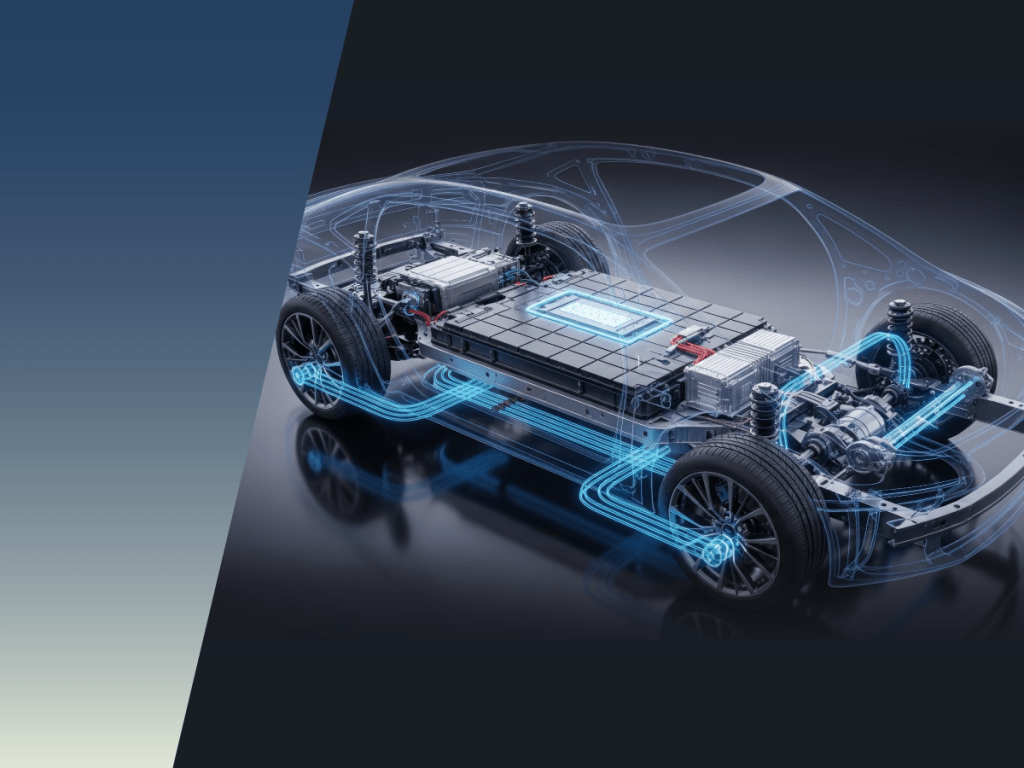
Reliable Sensing for Safer, More Efficient EV Systems
Learn how reliable sensing supports safer, more efficient EV systems. Explore applications in battery management, charging systems, fluid monitoring, and safety detection and discover how advanced sensing technologies help improve performance, reliability, and operational safety.
-

Designing High-Density Switching Architectures Without Sacrificing Precision
Learn how engineers can increase channel density while managing capacitance, crosstalk, and PCB design constraints in modern semiconductor test systems.